Showing posts with label Jackie King. Show all posts

Monday, November 10, 2014

Is It Okay to Break Writing Rules?


Jackie--obeying the rules
by Jackie King


I try to be a good citizen and rule-breaking goes against my nature. However, the older I become, the less sure I am that writing rules and regulations shouldn’t be broken...sometimes.


Learn the rules before you break one.
When I write something contrary to general writing rules, my first impulse is to delete the scene. This is because another writer once said that it was wrong. Lately, however, I've paused over the delete button, now aware that I might be making an error. I've learned to hesitate before making something disappear from my screen forever. I've become cautious about pushing that delete button. I leave the words for the moment and make the judgment later during editing. (Unless you’re on deadline, when you do whatever is necessary to finish on time.)

When I wake up with a scene in my head that breaks all of the rules and my old writing teacher’s voice shouts inside my head, “YOU CAN’T DO THAT!” I do it anyway.
 
I can't do what?
I key in whatever words fill my mind, and try to put my heart on the paper. If this sounds messy, it’s because it is. Very. And hard. And exhausting. I’ve mentioned to other writers how exhausted I am after writing. Most agree. The average person, husbands, wives, etc., don’t get this, and there’s no reason they should, unless they also write.

One rule you should follow:
Back when I taught fiction classes I told my beginning students to commit themselves to writing 30 minutes a day. The important thing was to write every day, I assured them.

Several hands always went up. “But, I love writing and want to write for hours and hours,” students would say and most of the class would agree.

“Just make sure you clock 30 minutes. It’s harder than you think,” would be my answer.

The next week at roll call, I’d ask, “Did you write every day?” Few could answer, “Yes.”

No one knows how hard it is to put your heart’s blood on paper except those who write every day.

In each class there would always be one or two who ‘got’ what I was saying. Those were the students who became selling authors. You just have to stay with it. You have to plod through the days you wonder what on earth ever made you think that you could write.

But sometimes…
Usually I follow the rules. Today I may break one.

My Grace Cassidy Mysteries:

      
#1 in series

#2 in series


No. 3 in series is now a work-in-progress
Working title: THE CORPSE AND THE GEEZER BRIGADE


Tuesday, October 21, 2014

A Weird Kind of Storyboarding

by Jackie King
 

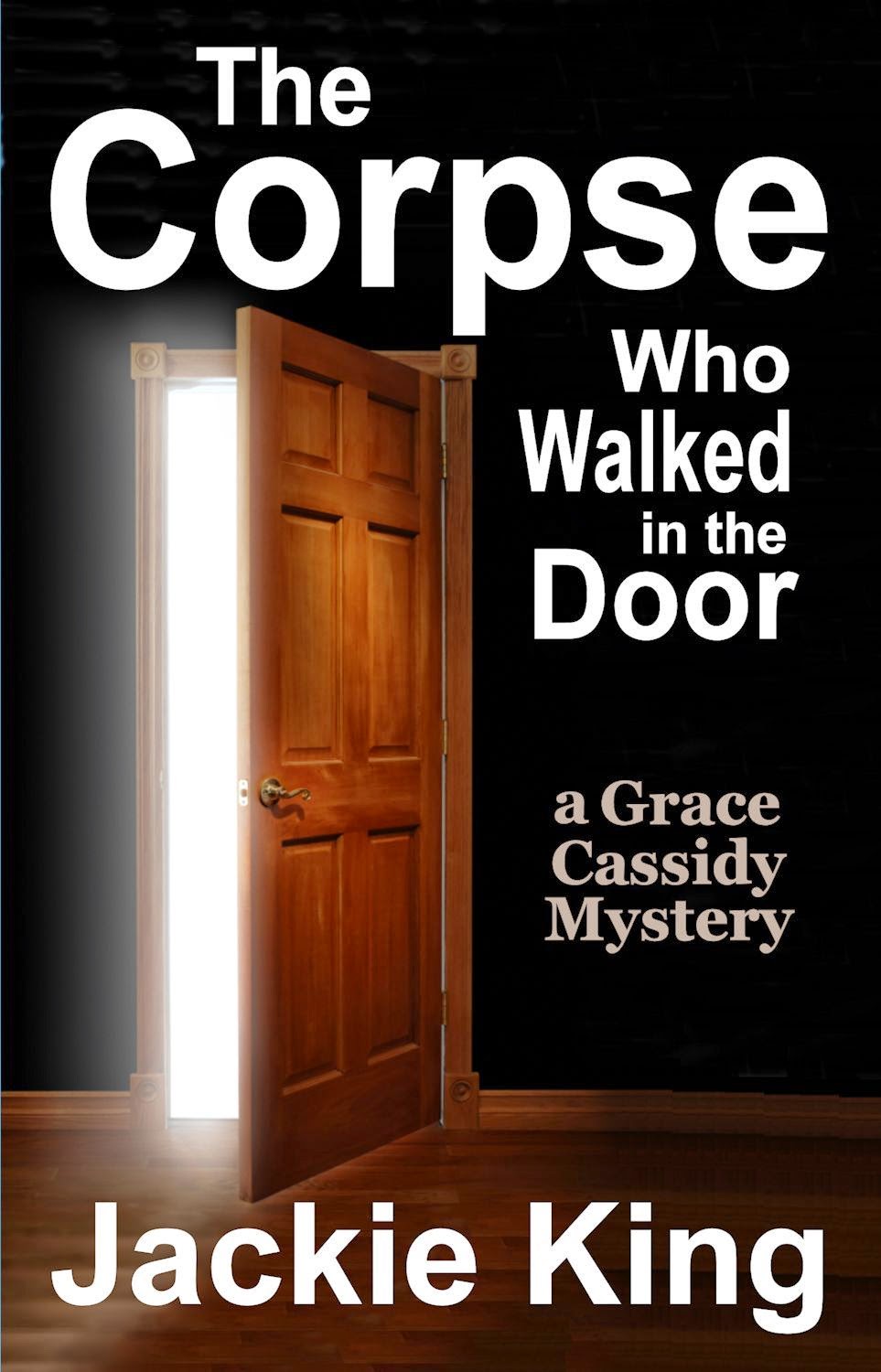
The amount of time it took me to write my second Grace Cassidy mystery, THE CORPSE WHO WALKED IN THE DOOR, was downright embarrassing. To avoid this on my third in the series, I researched storyboarding and plotting. Then I told anyone who would listen that I would block out each and every scene before I typed one word in my third Grace Cassidy mystery.

 Book 2 in the Grace Cassidy Series
2nd Grace Cassidy Mystery

Well, I lied!

Sorry about that.

My intentions, as always, were pristine. (And, yes. I do know the name of the road that’s lined with good intentions. My mother explained all of that to me when I was 13.)

But in my own defense, is it my fault that the headlights of my brain only show me a tiny stretch of the road ahead? (You can blame God, if you like, since he created me. But first you should know that He and I have already agreed that He’s always going to be right, no matter how good of an argument I manage to offer.)

I began my storyboard for my 3rd Grace Cassidy mystery in good faith. I bought a bulletin board at Walmart for ten bucks, came home with my purchase and marked it into four sections with masking tape. Feeling very self-righteous and completely sure of my success in this project, I started making plot points on index cards, as I’d always done.
1st Grace Cassidy Mystery

This grew old in a hurry. My fingers started to cramp. (I am an old girl, after all.) Then it occurred to me that I could type much faster than I could write in longhand. So I finished my notes on Word. Then I changed the margins so I could cut each note in an index card size. These I pinned to the board.

The first section was filled when suddenly the characters came to life and started talking inside my head. The problem was, they said what they wanted to say, not what I had planned. And since I’m sort of a wishy-washy person, I didn’t argue with them, but just followed blindly. (For some weird reason there seems to be a sort of magic connection between my fingers and the story. I’d be a real bust at dictating).

I’m still convinced that storyboarding is the right way to go and might save me a year of rewrites. Therefore my storyboard for my 3rd Grace Cassidy mystery is still in progress. However, my method evolved. (Some writers work with files and some work with piles. I’m a pile person.) I now pin the plot progress on my board as I go. I’m a gal who must write as she goes. I start with a premise, knowing only who has murder in their hearts, and why and who. The rest I learn as I write.

I wish I could be a strict plotter, but it seems I can't. I have to write "by the seat of my pants."


Oh well, it worked for the pilots in the 1920's maybe it will work for me too.

Thursday, September 4, 2014

September Is Blog Tour Month!

September is blog tour month celebrating my second Grace Cassidy Mystery THE CORPSE WHO WALKED IN THE DOOR. Since I’m determined to get book 3 out ASAP, I asked the Partners in Crime Blog Tour group to help with this. They’re wonderful! There are plenty times for readers to sign up for a chance to win a copy of THE CORPSE WHO WALKED IN THE DOOR. So follow the tour, leave a comment or sign up as directed, and maybe it will be you!

 Book 2-Grace Cassidy Mystery

The first give-away on Words by Webb, will be open for the next 15 days! Other opportunities will be given on most of the participating blogsites.

 Book one--The Grace Cassidy Mysteries

Book one: THE INCONVENIENT CORPSE IS ALSO AVAILABLE: Both on Kindle at Amazon.com. $3.99 each


1.
2.
3.
4.
5.
6.
7.
8.
9.
10.
11.
12.
13.
14.
15.
16.
17.
18.
19.
20.

Tuesday, September 2, 2014

What Is Going on with Me!

Killer Nashville August 2014

by Jackie King

Killer Nashville rocks! I highly recommend this mystery con for mystery writers or for any writer who needs an excuse for a fun trip. The conference was scheduled over the weekend, August 22 through 24. T.D. Hart, my traveling buddy, aka Jennifer Adolph, and I left on the Wednesday, August 20. We went early to attend the Sister’s in Crime workshop on Thursday afternoon, which was titled: DOING TIME WITH SinC: GREAT BEGINNINGS. We brought the beginning of our current WIP, up to 200 words.


Hank Phillippi Ryan with T.D. Hart (Jennifer Adolph)
 The presenters were Laura DiSilverio, (president of SinC), Catriona McPherson, Cathy Pickens and Hank Phillipi Ryan.

The president read our copy, which felt a bit like taking your clothes off in public and letting everyone critique your body. In other words, it took courage. But wow! Did we ever get some great tips. As soon as I came home I immediately rewrote my beginning. What I learned was well worth the cost of an extra night at the Omni Hotel (First 5-star hotel I’ve ever stayed in.)

Killer Cozy Panel

I was on the KILLER COZY panel at 10:00 on Friday morning. Panelists: Jennie Bentley/Jenna Bennet, Kay Elam (panel leader), Caroline Fardig and Nancy Parra.

MWA Party-Killer Nashville 2014


Book one in Grace Cassidy Series


Book Two of the Grace Cassidy Series


REVIEW AND GIVE AWAY FOR "THE CORPSE WHO WALKED IN THE DOOR"

CLICK HERE TO ENTER


Wednesday, June 25, 2014

Desperately Seeking Discipline

by Jackie King

The most successful authors I know all share one trait. Self-discipline. Discipline is more essential for a writer than creativity. Discipline is to be desired above either talent or creativity.
A disciplined individual, who decides to write, can learn fiction and nonfiction techniques and master the craft. She/he can learn basic plot types and can use these tools to practice creating stories. Creativity can’t be taught, but a clever person could learn character development, basic plot formation and then learn to apply these techniques to produce an entertaining story. And then another entertaining story.

A creative individual, who writes only when she/he feels inspired, will be lucky to finish even one book, much less enough work to form a career. Inspiration is a fickle work tool. And many editors and publishers tend to agree with me. Mine is included in that group. Regardless of the talent involved, before a work can be edited and published, it first must be completed. That’s where discipline comes in handy. And, oh, how I wish that quality was my long suit. But alas, it is not.
So each day I must strive to put my behind in the chair that sits in front of the computer, my fingers on the keys, and coax pouting characters to come out and play.
These characters, like cats that have been left behind while the family vacations, are angry and refuse to acknowledge my presence. To be honest, I don’t blame them, and must continue paying penance until I am forgiven. Let’s hope that is soon.
J
Hugs,


Jackie

Monday, May 12, 2014

I've Been Gone, but I'M BACK!!!!!!!!!!


Friends TD Hart and Rhenna Morgan at OWFI Conference. The fun begins. ;)
TD Hart (L) and Rehenna Morgan 


Baton Blog Hop

T.D. Hart, a critique buddy who writes cutting edge thrillers, tapped me for what she calls a Baton Blog Hop: basically a game of tag for writers. The idea is to answer four questions about your writing, then tag another author to do the same. But first you need to know about her blogsite, http://tdhart.blogspot.com
T.D. Hart Mysteries and Thrillers
Because Darkness Makes the Light More Beautiful
This is a must-read, especially if you love thrillers.
TD Hart is currently finishing revisions on a Noir Mystery about a San Diego homicide detective who investigates the murder of a rock star she had a crush on as a teenager. Seventeen years ago my character's sister disappeared from a crowded beach, and the singer's voice was literally ringing through her speakers the moment she realized her sister was gone. The working title is LIFE FOR A LIFE. Does that sound good or what? I can hardly wait for this novel to be published.
~~~~~
Now for the questions that I’m supposed to answer:

What am I working on?
My current work-in-progress, a novella, has the working title DANGER VISITS THE GOLDEN DRILLER. I’m writing this story for Smart Women Writers, an ultra-cool group of first rate writers. I‘m editing the draft now.

The tough decision facing me is which mystery should I write next? Characters from two different plots are vying for my attention. One is Grace Cassidy, my evolving character from her own series. My family brainstormed with me on Thanksgiving day with this plot idea, and the working title is THE DISAPPERING CORPSE. The story will be set in Tulsa, Oklahoma and I’m very excited about the plot twists.

The competing protagonist hasn’t told me her name yet. She’s pitching her story idea, and it’s a good one. Needless to say, she’s fast becoming my Best Pretend Friend. (I fear that Grace is getting a little tired of me. Perhaps we’ve been spending too much time together and we both need a break.) Of course, I could introduce this new person in THE DISAPPEARING CORPSE and let her spin off into her own series, sans Grace.

The third possibility is working on both of these novels at the same time. I’ve never done this, and would love to hear from other writers who have. Give me the pluses and the pitfalls.

How does my work differ from others in its genre?
My books are different from other cozies because I wrote them. This sounds like a smart-alecky answer, but I don’t mean it that way. When a writer finds her/his authentic voice, that work is unique from any other. I write from the heart (some call it from the gut), as much as is humanly possible. I try to tell the absolute truth as I see it. Even though the story is made up, I try to put myself in the skin of each view-point character. I let my lead character, Grace Cassidy, evolve with the series. She is a middle-aged woman whose lifestyle ended abruptly. Her determination to rebuild herself from ashes, is something that many women face during their lives.

And then, of course, all of those corpses keep showing up.

Why do I write what I do?
I write the kind of book that I enjoy reading. Agatha Christie is my all-time favorite author and role-model. Because of the great pleasure her mysteries gave me, I write cozies. I include women’s problems in my mysteries, because I was blessed to strong women in my life. These real-life heroines never gave up, no matter what fell into their path.

How does my writing process work?
First I turn on my computer and bring up Word. That’s the only constant in my routine. I’ve searched for that magic button, but the only magic I’ve received was a yellow button from a book doctor named Robyn Conley. She handed each person in her class a button and said: “Put your butt on the seat, your fingers on the keys, and type. I lost that yellow button (so typical of me), but I have remembered her words.

Well, that's it. I'm going to tag two of my writer buddies!

Bob Avey, who writes about a tough police detective with a soft underbelly. He will post next Monday, May 19 on his blog, which is attached to his website.
http:bobavey.com
The other writer is Linda Trout, who looks like a fashion model and writes take-your-breath-away thrillers. All of this with a touch of romance.


Do yourself a huge favor and check out these two writers.
Cheers,
Jackie

Tuesday, April 2, 2013

The Birthing of NO ESCAPE: The Sweetwater Tragedy


Jean Henry Mead's new historical novel, NO ESCAPE, is ready for downloading now! Today, the author tells how this book came about. Read her riveting account of "Cattle Kate's" courage. If you love mysteries, history and strong women, this is the book for you.

~~~~~~~~~~~~~~~~~

Jean Henry Mead
 
No Escape, the Sweetwater Tragedy

By Jean Henry Mead

I was researching a Wyoming centennial history book during the mid-1980s, by reading old microfilmed newspapers dating from 1888. During that time I read about a young woman named Ellen Watson, who had been hanged by cattlemen along with homesteader James Averell. The cattlemen who hanged them claimed that the pair had been operating a rural bawdy house and taking cattle for Ellen’s services.

After her death, the hangmen labeled Ellen “Cattle Kate” and vilified her by claiming that she was not only a prostitute but a cattle rustler. The Cattlemen’s Association, headquartered in Cheyenne, controlled a local newspaper and reports of the hangings were published worldwide, resulting in considerable condemnation that a woman had been hanged, despite the cattlemen’s claims.

I was curious when I read the 1889 newspaper reports, when the murders took place, and decided to write a novel about them, someday. A number of authors had written about the hangings from the cattlemen’s point of view, and films have been produced, portraying Ellen as a pistol packing outlaw. But that didn’t jibe with news reports from the Casper Weekly Mail, which published James Averell’s “letters to the editor,” complaining that greedy cattlemen were gobbling up all of Sweetwater Valley, so they could graze their cattle on government land, without paying for it.

I researched the story intermittently over the years but pieces of the puzzle were missing until George W. Hufsmith was commissioned to write an opera based on the hangings. He was hooked on the story and spent the next 20 years interviewing residents of Sweetwater Valley, Wyoming, who had knowledge of what had actually happened. Thanks to Hufsmith’s nonfiction book, I was able to write my novel. I dedicated the book to him.
 
I didn’t want to end the novel with the Averells’ deaths so I included a young, single woman homesteader in the plot to tell the majority of the story.  During my research I discovered that some 200,000 single women tried their hands at homesteading: some successful, some not.


Thanks Jean, for the background to your new and exciting novel.
And thanks to our readers for dropping by.
Jackie King


Monday, January 16, 2012

THANK GOD I ONLY HAVE TWO EYES!

I’ve just spent the last few days remembering my first detached retina in 2008. It was a harrowing experience, but the awfulness of the experience soon faded from my consciousness. Then just before Christmas 2011, my right eye developed symptoms.

It wouldn’t dare! I thought, but just to be on the safe side I went back to my retina specialist as soon as his office opened after the holiday.

“You have another detached retina,” he said. “Do you have someone here to drive you home? We’ll repair it now, just like we did before.”

Well, of course I didn’t have a driver. That would have been admitting that I might really have a problem. So once again I had to call a daughter to come and chauffeur me home. And once again I got fussed at for not telling my daughters that I was having a problem. (I think that’s why grandparents and teens get along so well; we’re both always in trouble with the same parents.)

I’d forgotten about the foot-long (or so it seemed) hypodermic needle, the frozen face afterwards and the deep eye pain. But soon I remembered it all. And once again I lived through it.

My writing was interrupted for a while as were other pleasant routines of my life, but finally I was nearing the end. I’m even almost finished with my steroid drops. Once again I have my sight restored and am feeling grateful. This time because I only have TWO eyes!

Hugs to all my reader and writer friends,

Jackie

Sunday, January 15, 2012

DETACHED RETINAS COUNT AS OTHER MADNESS-PART 4

(Continuing from yesterday's blog about my first trip back to the doctor...)

The nurse seemed unmoved by the fact that I couldn’t see squat. Then the doctor came in and finished his examination and said to continue “positioning.”

“But I still can’t see anything,” I said.

“As you heal your vision will improve,” he said.

This time he gave me permission to stay home alone. In order to make this work, Jennifer became my chauffeur and Susan my maid. It was comforting to be in my own house, but my usual entertainments of reading and writing could only be done in “the position.” Not being “Rubber Woman,” I spent most of my time listening to the cooking channel; white noise to quiet my ever-racing mind and imagination.

Days passed slowly. Boredom was broken only by Susan’s daily visits to tidy my kitchen, empty trash, sort through and read me my mail, and other such mundane tasks that we hardly notice in normal times. But suddenly, every small detail of life became a challenge. My big event of the day was showering and shampooing. (What a relief to be able to stand tall once again, even with one eye tightly shut against water and shower gel.)

I adopted my friend Peggy Fielding’s method of life; the one she calls “The Swiss-Cheese Method:” one small task at a time. Then I would reposition. Peggy called me and talked for brief periods, knowing that every act of life was complicated by my enforced awkward position.

And those eye drops! The never ending eye drops with a schedule so complicated that Susan charted my times with spaces to check off when completed. What a Godsend to have a private licensed Occupational Therapist at my beck and call.

Life without reading and or writing is like a life without sunshine. What do people do who don’t read? What seemed to me like my Technicolor life turned into Black and White. The only advantage was plenty of time to meditate and pray.

Small victories filled my life. Obvious day by day improvement encouraged me to believe that I might eventually recover. On frequent trips to the doctor my eye was checked and progress tracked. I lived for the nurse’s smile and her encouraging, “That’s better.” Especially after it became harder for me to tell if there was improvement.

A big step was the day I was told I could drive, “When I felt like it.” But in order not to trouble my grown daughters, I promised to wait a few more days. (I once was a mother with two daughters, now I’m a daughter with two mothers. How lucky can one woman be?)

And the thought of driving seemed intimidating. I longed for the freedom driving permitted, but doubts troubled me. What if I banged up my new car—that shiny red sedan with the new-car smell I so loved? Although I’ve never received any traffic violations, I feared if I got one now, my girls might “ground” me, fearing for my safety.

Finally I decided to venture to the grocery store for bananas and a bottle of milk. I felt as excited and nervous as a 16-year-old with a brand new license. You’ve seen these folks creeping along and driving other drivers insane? That would have been me on that day.

Almost as quickly as I went blinded, my life was restored. I could read for my own entertainment in addition to handling my own housework and mail. My driving fears quieted, and I once again had wheels. But most important of all, to me at least, I could write.

The first day I put in a serious day of writing, I felt exhausted. So I realized that, like everything else, I’d have to work toward my ultimate goal a bit slowly.

The last milestone was being able to exercise on my treadmill. The doctor wouldn’t release me for this until about two and a half weeks had passed. Again I began very slowly and for shorter lengths of time. But the important thing was:

I had my life back!
To be continued tomorrow…

My best wishes and healthy reading eyes to one and all,

Jackie

Saturday, January 14, 2012

The Sad Tale of My Detached Retina

THE NEEDLE FROM HELL IS STUCK INTO MY EYE!

After learning that the local anesthetic to be used would be the same as used to earlier remove a cataract from my other eye—a procedure I was put under general anesthetic to accomplish when I was conveniently at the hospital—I prepared myself mentally to face exceptional pain. Not an easy task for a self-admitted coward.

But my life was centered around writing and around reading, and good vision was essential to preserve my quality of life as I now knew it. I was willing to endure any type of torture in order to be able to see. Still I was scared. I longed to be someone else for the next couple of hours—to transport myself into a character drawn from my imagination whose circumstances I could control by changing the plot.

I took a deep breath then I called a close friend to ask for prayer.

After the surgery was completed the doctor asked me how I was doing. I was so relieved to have everything over I generously said, “I’ve been through worse.”

He laughed. “I love having women for patients, after childbirth nothing seems overwhelmingly painful to them.”

“I’d have gone through much more pain in order to save my sight,” I said.

During surgery my youngest daughter, Jennifer had arrived. Her facial expression warned me that she was wrestling with both worry and annoyance. I prepared myself for being scolded, but worry must have won out because she spoke in a carefully controlled tone of voice.

“I know you like to be independent, but I want you to promise that the next time you have an emergency, you’ll call me.”

“I’m sorry, sweetie,” I said. “But I know how busy you are. I just thought I could manage on my own.”

Dr. Garrett gave me a preliminary shot, much like that the dentist gives before drilling a tooth. He even made the same shaking motion, saying he’d learned that technique from his own dentist. Next came a needle I thought looked long enough to reach my belt buckle. I closed my eyes and reminded myself that nothing lasted forever.

This shot, which would numb the entire half of my face, taking until the next day to completely wear off, was unpleasant and uncomfortable. But I’ve endured worse—even in the dentist’s chair. The eye was prepared with more drops as time was allowed for the numbing to set in.

The doctor used a freezing technique to repair my retina, and then he inserted an air bubble to hold everything in place. But in order for the bubble to be in the correct spot, I was instructed that for the next two weeks I had to “position” myself for most of the time. At night I had to sleep on my side, my face turned downward. My neck hurt just thinking about that.

He pulled a chair next to me, bent at the waist, rested his chin in the palm of his hand with his elbow in the palm of his hand.

“Like this,” he said.

I mimicked his position until he was satisfied that I understood. I was told to go home and do this for an hour, and then to position myself in sleep mode and stay there the rest of the evening. I was so exhausted I wasn’t sure I could walk to the car, and any kind of a prone position sounded good to me.

The next morning daughter Jennifer took me to the doctor bright and early. The nurse removed my eye patch. I was excited but apprehensive, because I knew there was a chance this procedure wouldn’t work. Also, I’d been told that this easier approach was instantly successful. So I expected to be able to see pretty much as usual when the bandage came off.

Fear washed through me when I opened my eye. Instead of a black nothingness, I now had a blurry gray nothingness. I assumed the surgery had been unsuccessful and I steeled myself to hear the results.


To Be Continued…

See you tomorrow,
Jackie

Friday, January 6, 2012

A SECOND DETACHED RETINA AND JANUARY TO BOOT!

“Thank God I only have two eyes,” I said to daughter Jennifer, co-author of my one and only nonfiction book, DEVOTED TO COOKING. Jennifer laughed, knowing it was a joke, but neither of us was feeling very merry. She was driving me home from having surgery on my left eye for a detached retina. This was my second time to have such a problem, and like most unfortunate happenings the timing was extremely inconvenient.

http://www.amazon.com/Devoted-Cooking-Inspiration-Aspiring-ebook/dp/B003UNLC24/ref=sr_1_1?s=digital-text&ie=UTF8&qid=1325874055&sr=1-1

Christmas Eve, 2011, it seemed as if a curl had fallen over my eye. Without thinking I tried to brush this nonexistent curl aside, and nothing changed. My heart sank. It wouldn’t dare, I thought! Three days later the doctor performed emergency surgery and I knew from experience that I was in for a hard two weeks. This was my second trip around the block for a detached retina. The first time was even more traumatic.

Suddenly Blind—April 2008

On one of the best days of my life I went suddenly blind in my left eye. That glorious April day morphed into being one of the scariest days of my life. Along with the other two authors of Statehood Foxy Hens and Murder Most Fowl, I was about to travel back to Tulsa from Oklahoma City. We had just finished a successful speaking engagement at the Cowboy Hall of Fame. But the glow disappeared when an invisible curtain that could have been made of 4-inch black velvet suddenly blocked almost all sight in my left eye. Only a sliver of light was visible in the upper left-hand corner of half of my world.
  http://www.amazon.com/Foxy-Statehood-Hens-Murder-ebook/dp/B004HYHCYC/ref=sr_1_1?s=digital-text&ie=UTF8&qid=1325874166&sr=1-1

Terror blitzed my brain and my reasoning powers froze. My mostly-healthy body had failed! Visions of tapping along with a white cane and learning Braille flitted through my writer’s imagination. I was so scared I couldn’t even speak. I felt unable to communicate my dilemma with my co-authors and friends, Peggy Fielding and Paula Watkins Alfred. If I voiced what had happened it would be real. So I retreated into the comfort of denial.
L to R: Paula Alfred, Peggy Fielding, Jackie King
“You’re really quiet,” Paula said, flashing me one of her dynamite smiles.

For a sensible person, this would have been the time to share the unthinkable thing that had happened. But I couldn’t. Making such a shocking declaration aloud would mean that it was true. So I hedged.

“I’m a private person,” I said a bit woodenly. I knew my smile was tight and no doubt phony, but the trauma seemed to seal my lips.

“She’s a Pisces,” Peggy Fielding said from the back seat. “A dreamer, you know.”

Gratitude swept over me. Thank God I wouldn’t have to talk much on the way home. Little did my friends know that my dream was actually a nightmare.

(TO BE CONTINUED...)

If any of you have suffered a detached retina or other eye problems, I'd love to hear about them. Readers and writers need their sight!

Hugs,

Jackie

Thursday, December 15, 2011

Jackie King Shares

MY THREE RULES FOR WRITING
Which I borrowed  From the Best Writers on Earth

Rule 1: Don’t allow yourself to be intimidated. Books are written one word at a time, one sentence at a time, and one paragraph at a time. Each day remind yourself that all you have to do is write one sentence, and then one more, and then one more…

Rule 2: Give yourself permission to write a bad first draft. This removes the fear of failure. You can’t fail because it’s okay to write sucky pages. What’s hard is putting your heart on paper. Don’t listen to your internal monitor that says, “You can’t even spell.” (Like that makes any difference? Many successful writers can’t. That’s why God made dictionaries.)

Rule 3: Write every day. Determine to write even in chaos or tragedy, because life is seldom perfect. No matter how busy you are, you have a right to some time of your own; learn to recognize and grasp these moments. Keep either index cards or a notebook close at all times. (I prefer index cards and always carry some in my purse, pocket and car.


Peggy Fielding and me at outdoor signing in June. Too hot for boas!

Modern men and women spend a huge amount of time standing in lines, waiting at the doctor’s office, or the dentist or hairdresser, or for a child at private lessons or activities. Apprehend these moments to make character sketches, brainstorm writing ideas, or write a scene or part of a scene. It’s possible to write a scene in 20 minutes. I know one author who wrote her second book waiting at the airport for her next plane.

Get a large collapsible file to keep all of your notes, character sketches, newspaper clippings, etc., together. Writing time shouldn’t be wasted searching for lost notes. Keep that file somewhere handy and drop each scrap of paper or index card into it.

Writing a book doesn’t always happen in an organized way. Writers are creative folk and there are different ways to begin. Many things can trigger a germ of an idea from which a novel can develop: an overheard snatch of conversation; a newspaper or magazine article; a scene flashing through your mind unexpectedly.

Trust yourself and follow your intuition while you’re writing. This brings out that precious quality called “voice.”

Discipline is primary.

Talent is secondary.

Luck is nice, but a lack of luck can be overcome by persistence.

Use your experiences plus your imagination.

THE INCONVENIENT CORPSE is one thing I imagined first and then wrote down:


Hugs to all,
Jackie